1. Identify the parts
EN 1090-2 covers the execution of steel structures. Identification allows a part or a group of similar parts to be recognised during fabrication. A label is one possible method, but not the only one.
IDENTIFICATION • TRACEABILITY • CE MARKING
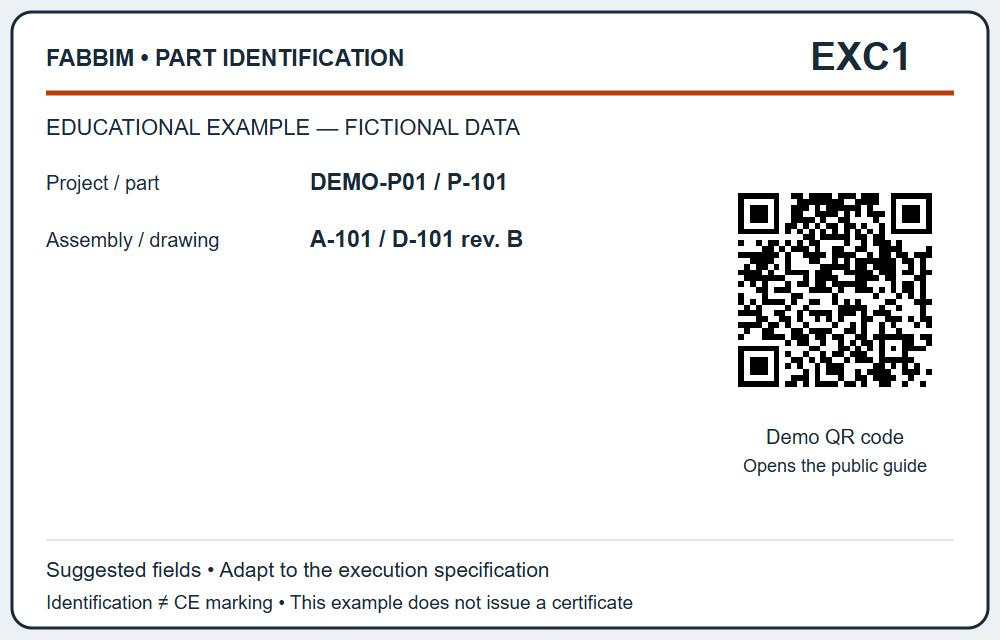
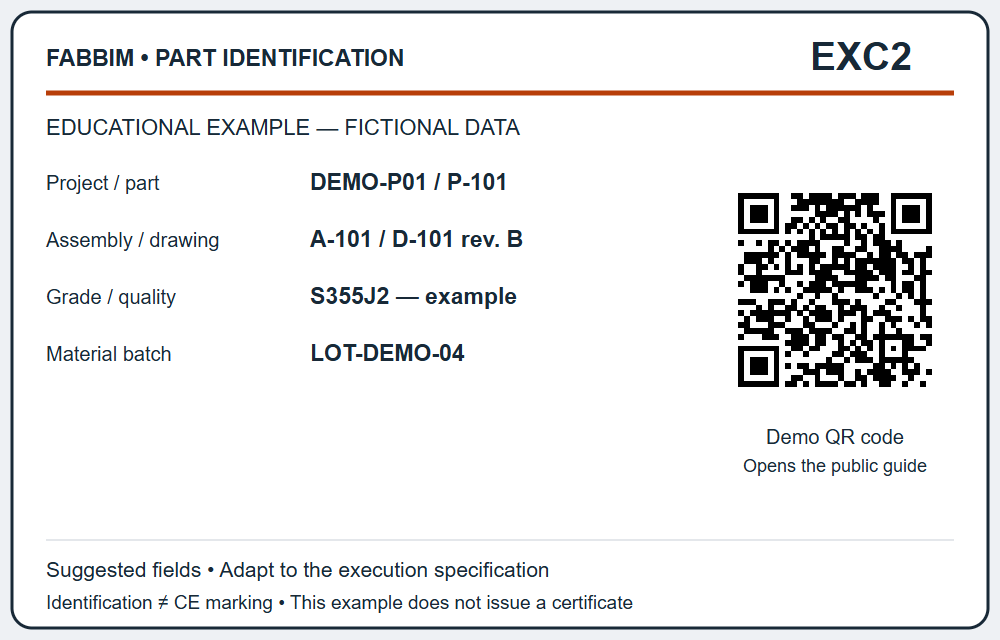
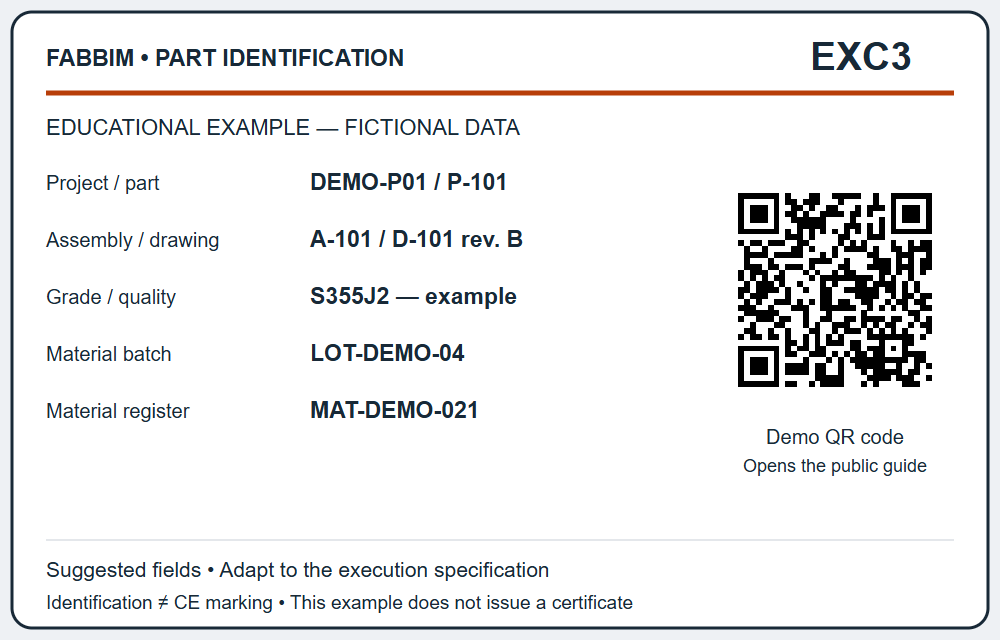
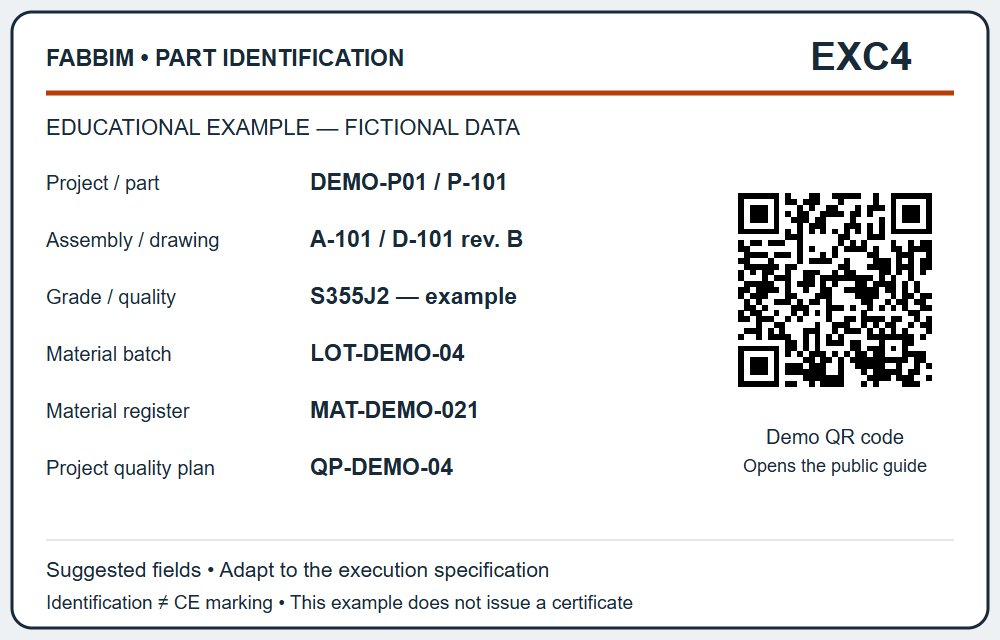
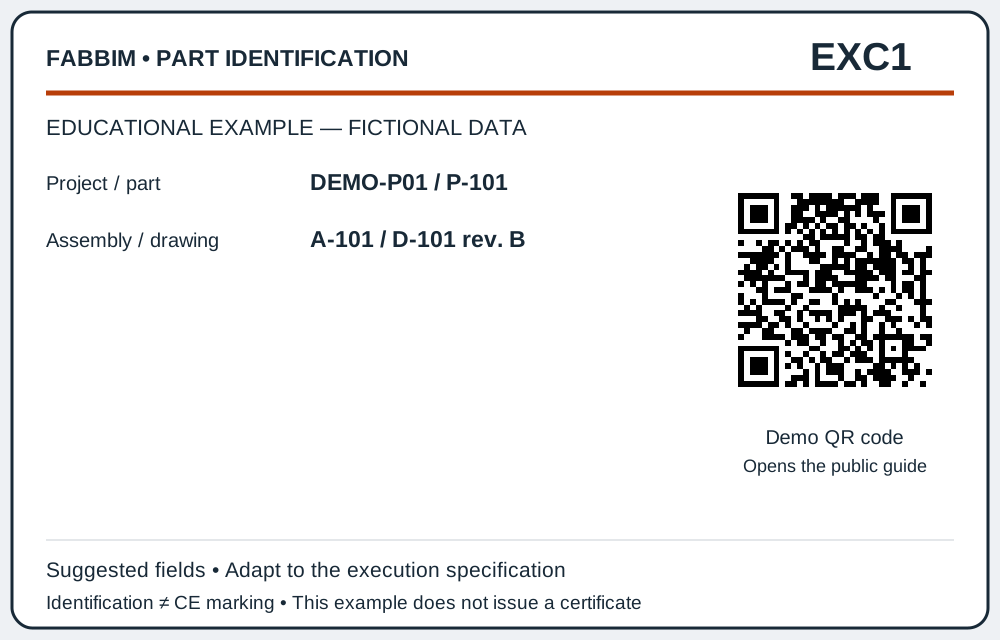
Four sample labels with QR codes explain what to display, how to maintain links to materials and which evidence to retain in the quality records.
View the four labelsEducational examples with fictional data. The execution class alone does not define a mandatory label template.
EN 1090-2 covers the execution of steel structures. Identification allows a part or a group of similar parts to be recognised during fabrication. A label is one possible method, but not the only one.
Material documents, links between parts and batches, welding records, inspections and the handling of deviations form part of the fabrication records. Not all this information needs to be printed on every label.
EN 1090-1 concerns the conformity assessment of structural components within its scope. CE marking and the declaration of performance have their own content requirements. A workshop mark or QR code does not replace them.
The current technical reference for steel is EN 1090-2:2018+A1:2024 (published in France as NF EN 1090-2+A1 in May 2024). For aluminium, refer to EN 1090-3: the examples below concern steel. AFNOR catalogue.
The execution specification defines the class for the project, structure or individual components. It cannot be determined from the words “shed”, “building” or “bridge” alone. A project in EXC2 may also require specific traceability provisions.
| Class | Identification and traceability | Implications for the proposed label |
|---|---|---|
| EXC1 | Identification during fabrication; comply with the project requirements. | A part mark, project and drawing reference help prevent mix-ups. The QR code is optional. |
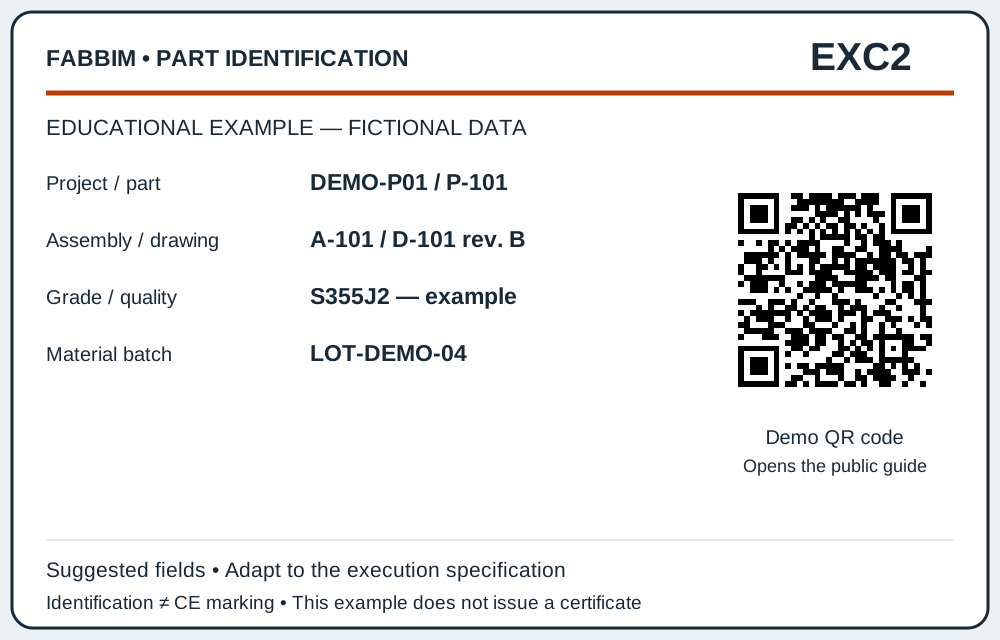
| EXC2 | Where different grades or qualities are in circulation, identify the grade and quality of the constituent products. | Add appropriate material identification. A batch reference helps link the part to documents according to the selected procedure. |
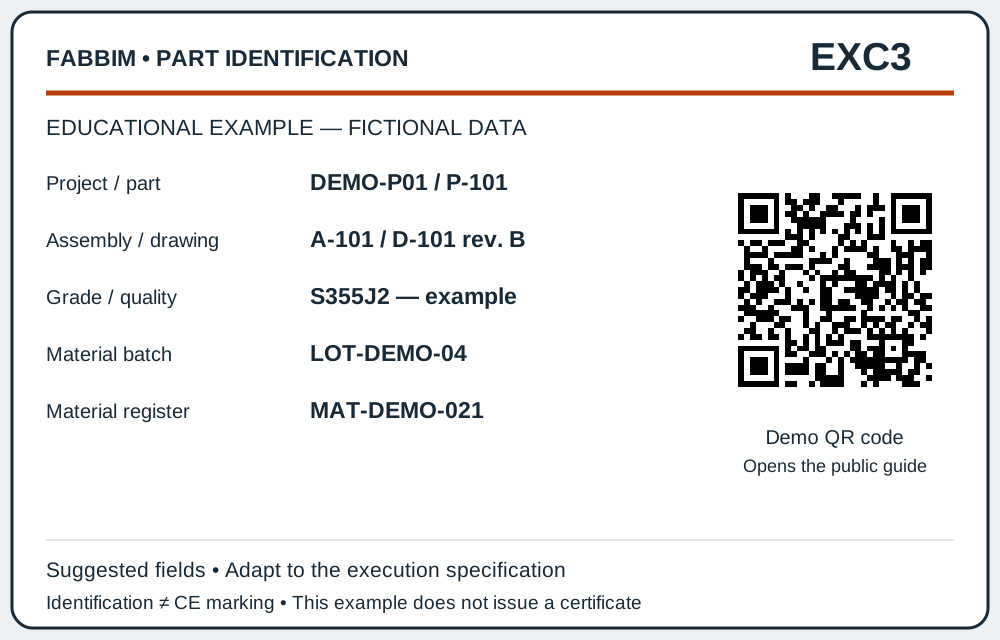
| EXC3 | Trace constituent products from receipt to handover after incorporation. Batch traceability may be suitable unless individual traceability is specified. | Link the part mark unambiguously to the material register. Printing every heat number is not a universal rule. |
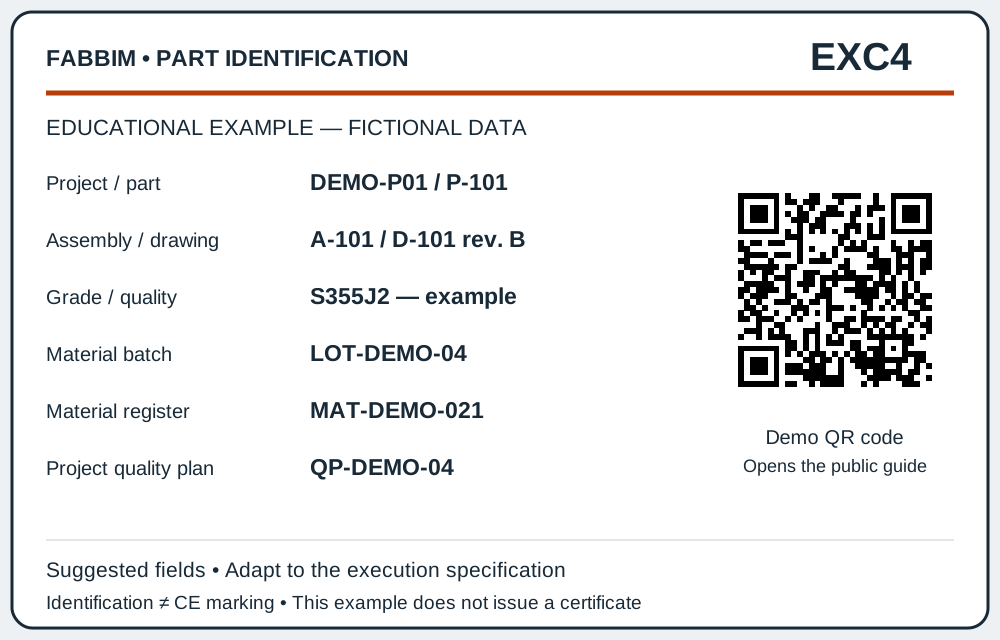
| EXC4 | Maintain traceability as in EXC3, together with the additional fabrication and inspection requirements of the project. | The example adds a quality plan reference for convenience. EXC4 alone does not require this printed field or a particular QR format. |
This identification summary draws on the European PROGRESS guide (2020, § 6.2.6). The guide predates the 2024 amendment and does not replace the current standard or project specification. Read the technical source.
These templates suggest a way to organise information; they are not four standardised labels. The project name, printed class, layout and QR code are presentation choices. S355J2 is an illustrative material grade, not a grade dictated by the execution class.
Each QR code opens the corresponding explanation on this public page. It does not provide access to a real project file. For production use, provide a stable link to the authorised part record and its documents.
Project DEMO-P01, part P-101, assembly A-101 and drawing D-101 revision B provide a practical basis for finding the correct part and drawing. Keep the required material documents and inspection records even when they are not displayed on this template.
The example adds grade/quality S355J2 and batch LOT-DEMO-04. The purpose is to prevent mix-ups and retrieve the applicable material document. The type of inspection document depends on the product and applicable requirements, not solely on the EXC class.
Reference MAT-DEMO-021 represents the link between the part, its batch and material documents. The records must maintain the traceability chain at the relevant stages. For an assembly made from several materials, retain the correspondence for every constituent; one printed heat number does not describe the entire assembly.
Reference QP-DEMO-04 points to the project quality plan. This is suggested information, not a label field made mandatory by EXC4. Inspections, their results and any specific requirements remain documented in the records; EXC4 should not be reduced to “100% inspection of every weld”.
The need for a type 3.1 or 3.2 material inspection document depends on the product, applicable provisions and contract. EXC4 does not automatically mean “a 3.2 certificate for every material”. Validate the document matrix with the quality manager using the standard and project specification.
For products still covered by Regulation 305/2011, Article 9 provides for the following information, among other things, to accompany CE marking:
These “performance classes” must not be confused with the EXC execution class. The marking must be visible, legible and indelible on the product or an attached label; where the nature of the product makes this impossible or unwarranted, it appears on the packaging or accompanying documents. Also check the applicable provisions of EN 1090-1. Article 9 of the Regulation.
Regulatory transition in 2026: Regulation 2024/3110 applies progressively by product family and new harmonised specifications. Do not assume that every product has already moved to the new regime, or that a digital product passport or QR code is now mandatory on every EXC part. European Commission explanation.
Select the substrate, attachment and marking method for the actual conditions: temperature, baths, abrasion, visibility and risk of loss. Ordinary paper labels or printed QR codes cannot be assumed to withstand galvanizing. The EGGA guide emphasises procedures agreed between the fabricator and galvanizer to preserve traceability. EGGA guide, 2014.
Fabbim identifies parts and assemblies from IFC or Tekla models and tracks operations through scanning. Preparing a label template should start with your part marks, workflows and project requirements. During the demonstration, check the available information and document links that need to be set up.
The EXC class does not define a universal label template. Compliance depends on the applicable requirements for the component, its execution and its placing on the market. The images above are not certificates.
The EXC class does not make QR codes mandatory. Here, a QR code is a practical means of accessing information. Continuity of identification and evidence remain necessary where required, with or without a QR code.
Not systematically. The required material correspondence must be maintained. An identifier can point to a reliable register. An assembly containing several products or heats needs records that distinguish their origins.
Yes, a common format may be suitable if the information and traceability arrangements meet the project requirements. The four examples illustrate possible additions, not a requirement for four different layouts.
Fabbim is a tracking and traceability tool. The software and labels do not replace factory production control or the applicable conformity assessments and documents.
The quality manager should check the template against the execution specification, workshop procedures and contract requirements. The execution class must come from the project documents, not from the choice of an image.
Research updated on 16 October 2026. Official catalogues confirm the edition of the standard; its full licensed text is not reproduced here. Dated technical guides explain principles but are not presented as equivalent to the current standard. Check this summary against the applicable text, national supplements and project requirements.